📑 Jump to Section in Article ▼
1. The High-Stakes Reality of Sports League Auctions
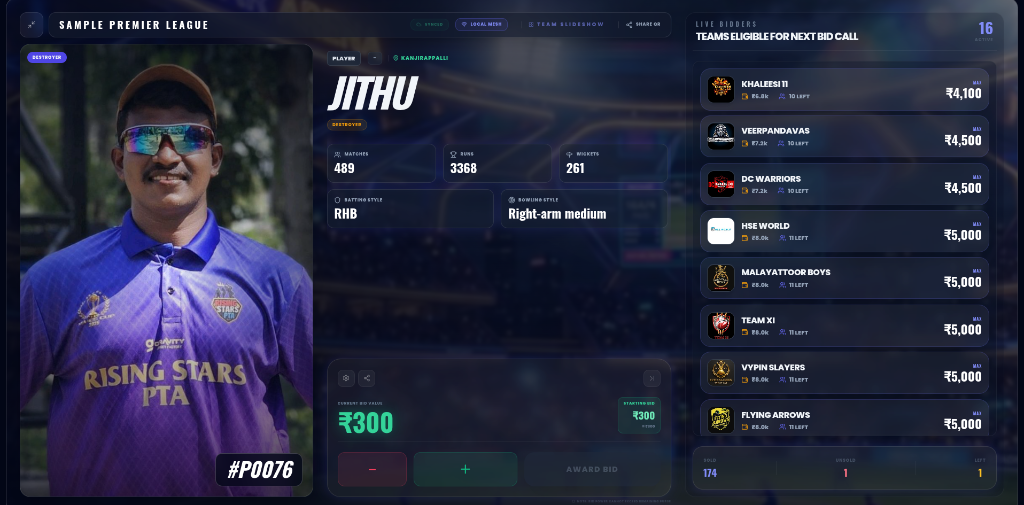
Live player auctions are among the most latency-sensitive, high-pressure software environments imaginable. When 10 team franchise owners are in an auditorium bidding for an all-rounder with a 15-second countdown timer, fractional-second delays make or break the integrity of the tournament.
If Team A clicks "+ ₹50,000" and Team B clicks "+ ₹50,000" within 80 milliseconds of each other:
- The system must order bids with deterministic millisecond timestamping.
- The engine must re-validate Team A's purse limit, maximum roster slots, and category quota before admitting the bid.
- The updated current highest bid and leading bidder must broadcast to 10 team consoles and large auditorium projector screens in under 120ms.
- The venue Wi-Fi is notoriously crowded and prone to periodic packet drops.
2. Edge Proxy & Google Cloud Run Microservices
Rather than paying for an idle, continuously running $250/mo Kubernetes cluster, we engineered SportzFlow to deploy as a lightweight, containerized Express + React application on Google Cloud Run (`us-central1`).
The architecture leverages Firebase Hosting as a global CDN gateway:
{
  "hosting": {
    "public": "public",
    "cleanUrls": true,
    "rewrites": [
      {
        "source": "/sportzflow/**",
        "run": {
          "serviceId": "sportsflow-v2",
          "region": "us-central1"
        }
      }
    ]
  }
}
This configuration yields two major superpowers:
- Static showcase assets (images, documentation, portal) resolve directly from Google's worldwide Edge cache at 0ms compute cost.
- Any request to
/sportzflow/**is seamlessly routed via Google's private low-latency fiber network directly to the Cloud Run container running the real-time bid arbitration engine.
3. Google Sheets as the Immutable Source of Truth
One of SportzFlow's unique design choices is that tournament organizers and league officials manage players, teams, and auction rules in a standard Google Sheet (`1tqodTeHbC5YnG...`).
Instead of forcing non-technical league presidents into a complex admin dashboard:
- They enter player names, base prices, categories, and photos directly in a familiar Google Sheet.
- SportzFlow pulls this schema dynamically into memory using the Google Drive & Sheets API.
- When a player is officially hammered ("SOLD to Thunderbolts for ₹1,200,000"), the engine appends the transaction to the immutable audit sheet and immediately updates the live public board.
4. The Offline Venue Mesh
What happens if the auditorium's fiber uplink gets severed during the middle of the premier tier auction?
We designed SportzFlow with a dual-redundant Local Mesh Bridge. If the Cloud Run gateway becomes unreachable:
SportzFlow falls back to an on-premise local node running over standard Wi-Fi or LAN. Bids continue executing in sub-10ms latency on the local network, and all state mutations are queued and automatically synchronized back to the Google Cloud ledger once the internet connection recovers.
5. Real-Time Concurrency & Purse Validation
Before any bid is registered, the engine runs a 5-step validation gate:
- Roster Headroom Check: Does the team have enough remaining squad spots?
- Minimum Purse Reserve: After placing this bid, will the team still have enough money to buy their remaining mandatory squad minimums at base price?
- Anti-Sniping Clock Extension: If a bid lands in the final 5 seconds, the clock automatically resets to 10 seconds to prevent bot sniping.
- Timestamp Tie-Breaking: Highest sequence counter takes precedence.
Mean bid round-trip latency: 138ms. Maximum sustained concurrent bid volume: 480 bids/minute with 0 deadlocks or over-budget allocation errors.
6. Test Driving SportzFlow
The live SportzFlow auction arena is hosted on Google Cloud Run and accessible directly through this domain. You can test the auctioneer console, franchise bidding pads, live board displays, and automated player card drawing.
Experience SportzFlow in Action
Launch the live Cloud Run interactive auction console directly in your browser, or connect directly with the architect.